
RadLoc: Radar-based 3-DoF Global Localization via Fast, Robust, and Lightweight Spatial Descriptor Across Diverse Environmental Scenarios
Authors: Hogyun Kim, Jiwon Choi, Jungwoo Lee, and Younggun Cho
Abstract: While global localization using spinning radar has gained attention for its robustness to adverse weather and challenging environments, many studies have focused on individual components such as place recognition or pose estimation. In this paper, we take a holistic view of radar sensor-based global localization and present RadLoc, a fast, robust, and lightweight end-to-end pipeline from place recognition to 3-DoF pose estimation. RadLoc accelerates pre-processing using 1D CA-CFAR filtering and leverages the near-range dominance in spinning radar images to design a compact descriptor and an efficient hierarchical coarse-to-fine retrieval strategy. Moreover, coupled with phase correlation-based 3-DoF pose estimation, it forms a versatile global localization module applicable to SLAM and multi-session SLAM systems. Extensive experiments on 15 sequences across 5 datasets demonstrate that RadLoc achieves robust performance while maintaining the smallest descriptor size and fastest retrieval time among state-of-the-art approaches.
Session: Localization and Odometry in Challenging Conditions / Monday, 09:01-09:03 / Paper #3941
Session: Poster Session / Monday, 11:00-12:30 / Exhibition Hall B
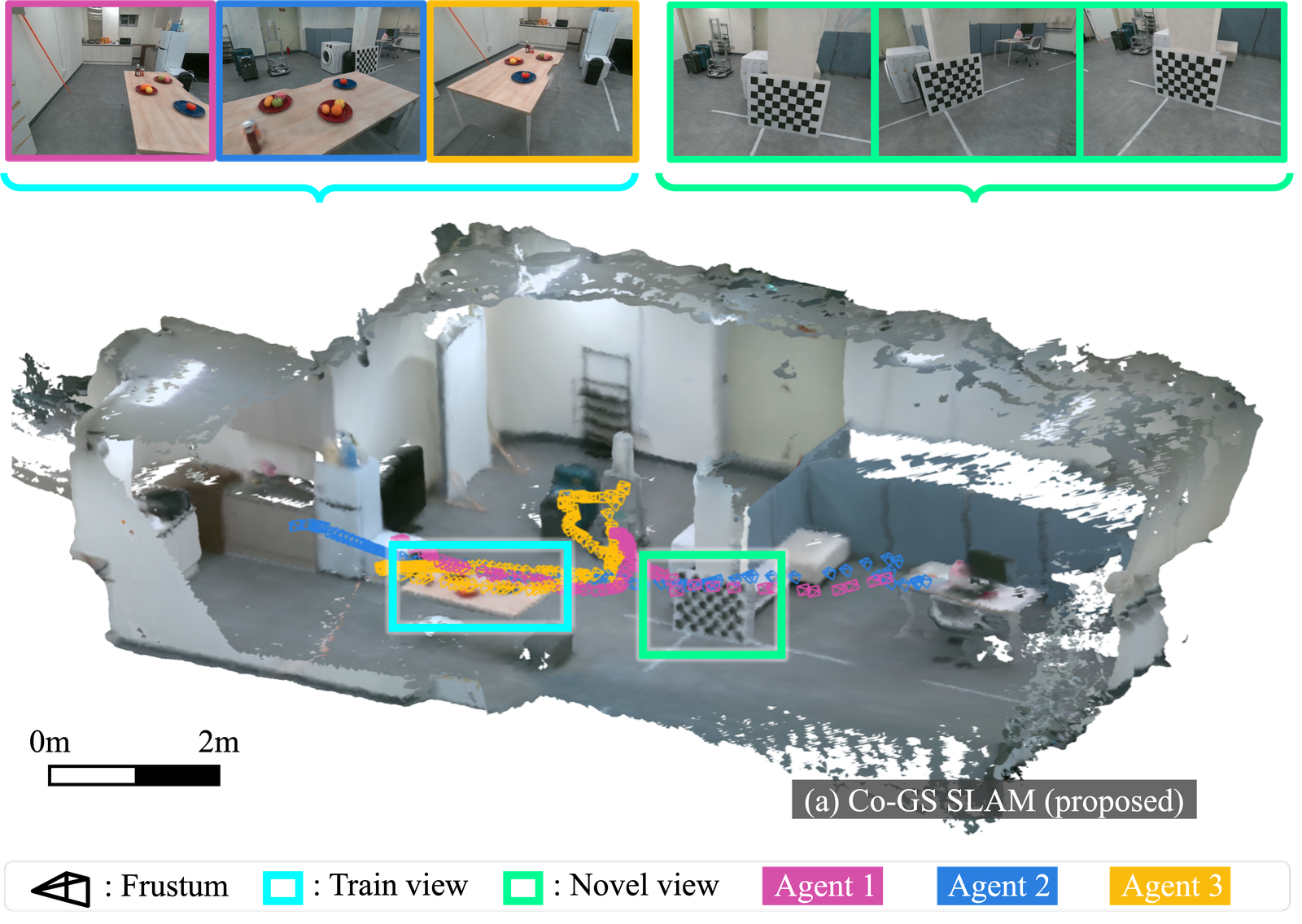
Co-GS SLAM: Collaborative 3D Gaussian Splatting SLAM with Pose-Dependent Gaussian Model
Authors: Taehu Sim, Hogyun Kim, Jiwon Choi, Juhui Lee, and Younggun Cho
Abstract: Collaborative 3D Gaussian splatting (3DGS) simultaneous localization and mapping (SLAM) provides scalable intelligence by merging the Gaussian maps that multiple agents build. To bring those maps into a common frame, each agent tracks its own odometry, and the server then closes loops between the agents by recognizing revisited places and estimating the relative pose of the matched keyframes. Building on this, state-of-the-art multi-agent 3DGS SLAM methods reconstruct scenes with remarkable rendering quality. However, once they are deployed in the real-world, they often suffer from two challenges: (i) intra-agent odometry error, where the odometry of each agent is not consistently accurate, and (ii) inter-agent constraint noise, where sensor noise corrupts the loop closures between the agents. To address these challenges, we present Co-GS SLAM, which refines the merged map and the keyframe poses of every agent together using a pose-dependent (PD) Gaussian model, achieving a geometrically and photometrically consistent merged map. Experiments on nine multi-agent sequences from four datasets demonstrate the highest rendering fidelity and the lowest trajectory error on all but one sequence. In addition, on our in-house dataset, recorded in the real-world, our Co-GS SLAM shows robust performance compared with state-of-the-art methods, averaging 4.1 cm of trajectory error against 11.8 cm and 10.0 dB more PSNR. Our code will be available upon acceptance.
Session: The Workshop and Competition on Intelligent Information Gathering for Single and Multi-Robot Systems / Sunday, 8:30-12:30 / Paper #16
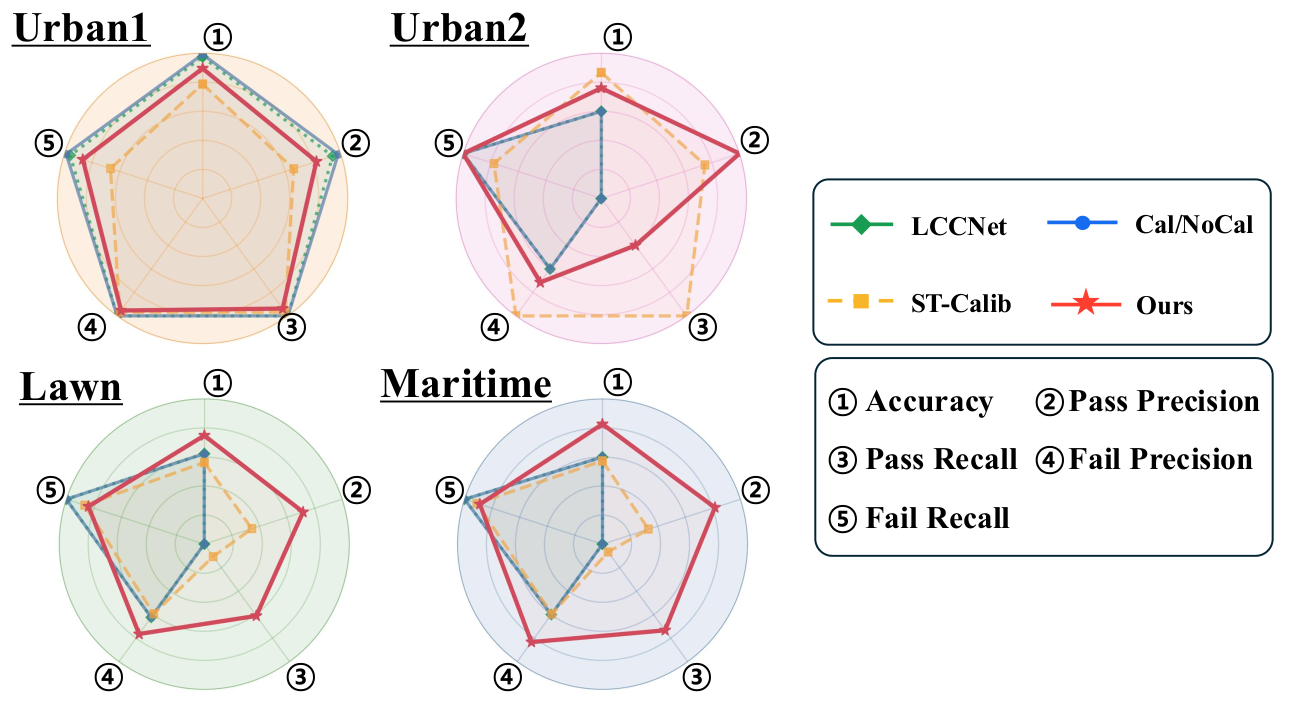
Cross-Environment LiDAR–Camera Misalignment Detection via Object-Level VLM Assessment (Spotlight & Best Paper Award)
Authors: Seokhwan Jeong and Younggun Cho
Abstract: This paper presents an introspective perception framework that extends reliability assessment from downstream perception outputs to the sensor alignment underlying multi- sensor fusion. LiDAR–camera misalignment is a persistent upstream failure that can corrupt fused representations even when both sensors continue to operate normally. We translate LiDAR–camera alignment integrity into an object-level visual assessment problem, enabling a vision–language model (VLM) to evaluate projected LiDAR depth patterns using a common set of human-defined criteria. After generating object-level projection images, we adapt a VLM to classify each object as Pass, Fail, or Unknown and aggregate the resulting evi- dence using a soft-voting ensemble for frame-level Pass/Fail classification. With all task-specific fine-tuning and ensemble training performed only on the KITTI Odometry benchmark and no target-domain adaptation applied, the proposed method demonstrates comparatively consistent performance across un- seen urban, lawn, and maritime environments. The results suggest that representing sensor alignment as an object-level visual assessment problem provides a transferable alternative to criteria based solely on environment-specific geometric cues.
Session: 3rd AI Meets Autonomy: Vision, Language, and Autonomous Systems Workshop / Thursday, 08:30-12:30 / TBD
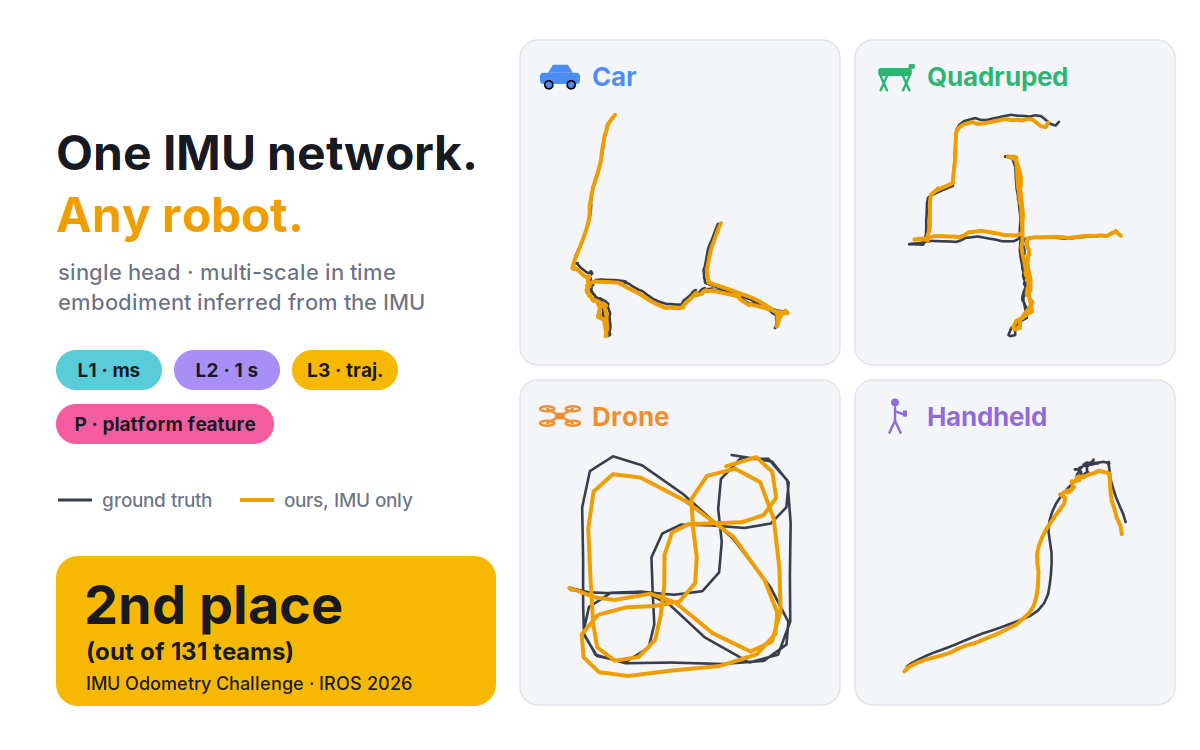
IMU Odometry Challenge 2026 (2nd Place out of 131 teams)
Authors: Jiwon Choi, Hogyun Kim, Jungwoo Lee, Geonmo Yang, Seunghee Yun, and Younggun Cho
Abstract: Inertial measurement units (IMUs) are mounted on almost every robot, which makes them a natural basis for one inertial model shared across platforms. However, the same IMU signal describes different motion on a car, a quadruped, a drone and a handheld device, and the platform is not given at test time. We propose a single network with one velocity head for all four platforms, built on two principles. Multi-Scale: the encoder reads the IMU from tens of milliseconds to the whole trajectory, using a residual stem, S4D state-space layers and a bidirectional GRU. Embodiment: a head infers the platform from the IMU alone, and its posterior conditions the encoder, the head and the output scale. We further adapt the network to unseen recording sessions by self-distillation on the unlabelled test inputs, towards a teacher refined by strapdown IMU integration. Our experiments showed that embodiment conditioning is necessary, since a model trained without one platform failed on it with 3.8–27× its in-distribution error. Our submission achieved a TartanIMU Score of 0.18405 over the 89 test sequences (ATE20 0.498 m, AVE 0.147 m/s, RTE 0.680 m) and 0.23110 on the public leaderboard.
Session: Beyond Exteroception: Interoceptive Perception for Resilient Robotics Workshop / IMU Odometry Challenge