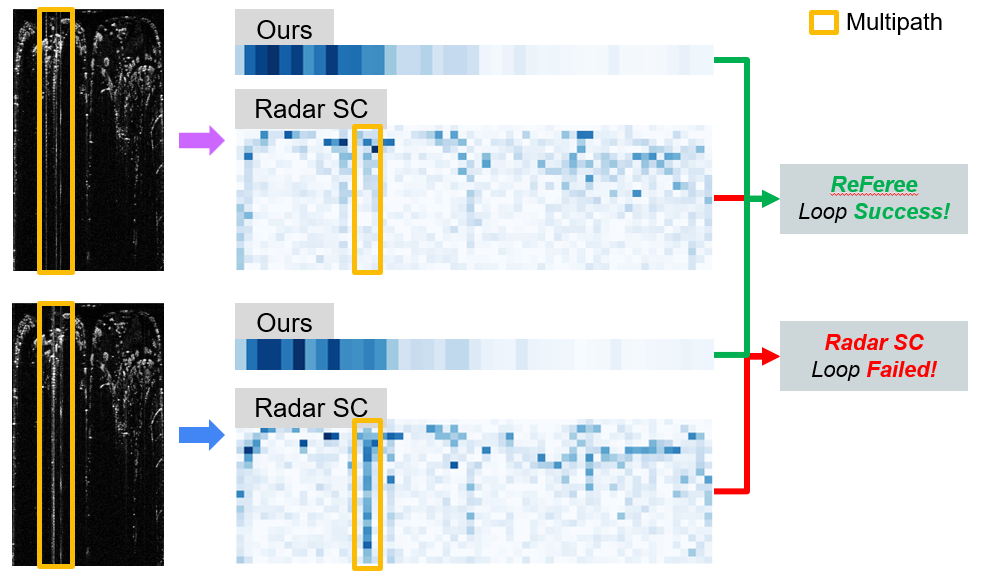
Place Recognition
Many radar studies focus solely on recognizing revisited places, designing descriptors and retrieval pipelines while leaving metric pose estimation out of scope.


While global localization using spinning radar has gained attention for its robustness to adverse weather and challenging environments, many studies have focused on individual components such as place recognition or pose estimation. In this paper, we take a holistic view of radar sensor-based global localization and present RadLoc, a fast, robust, and lightweight end-to-end pipeline from place recognition to 3-DoF pose estimation. RadLoc accelerates pre-processing using 1D CA-CFAR filtering and leverages the near-range dominance in spinning radar images to design a compact descriptor and an efficient hierarchical coarse-to-fine retrieval strategy. Moreover, coupled with phase correlation-based 3-DoF pose estimation, it forms a versatile global localization module applicable to SLAM and multi-session SLAM systems. Extensive experiments on 15 sequences across 5 datasets demonstrate that RadLoc achieves robust performance while maintaining the smallest descriptor size and fastest retrieval time among state-of-the-art approaches.
Radar-based global localization has advanced rapidly, but most prior work optimizes a single component in isolation. As a result, each line of research is tuned for its own sub-problem rather than for a complete localization system.
Many radar studies focus solely on recognizing revisited places, designing descriptors and retrieval pipelines while leaving metric pose estimation out of scope.
Others concentrate on estimating relative or absolute pose from radar scans, assuming the matching place is already known or coarsely provided.
Radar SLAM does cover the full localization-and-mapping loop, but higher-level tasks such as multi-session SLAM remain underexplored and insufficiently supported.
Our RadLoc takes a holistic view, covering the full stack from place recognition and 3-DoF pose estimation to SLAM and multi-session SLAM in one fast, robust, and lightweight pipeline.
RadLoc runs end-to-end across the full localization stack: place recognition, 3-DoF pose estimation, and SLAM, including multi-session settings under long-term and cross-weather variations.
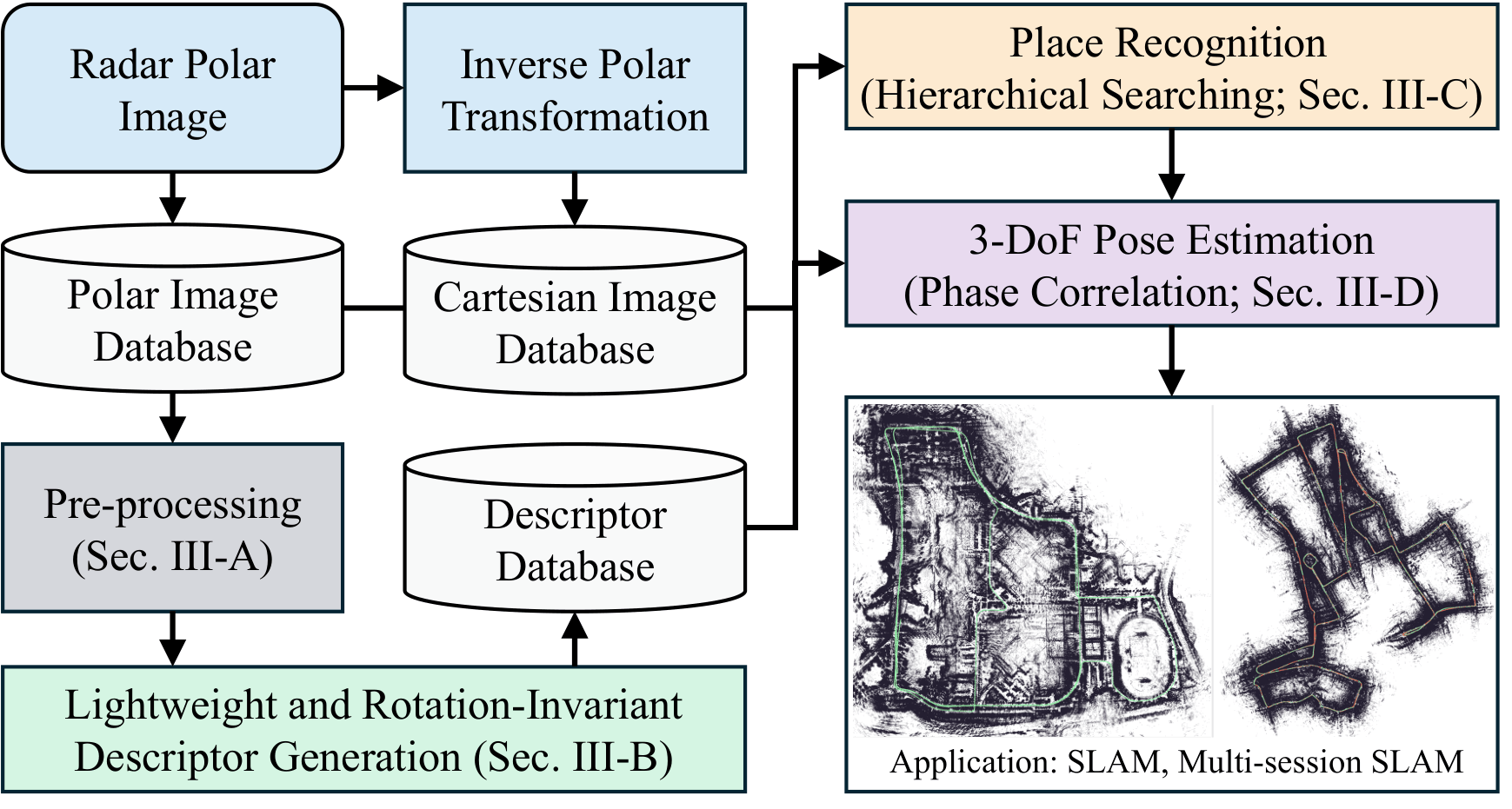
An overview of the RadLoc pipeline is summarized below. Given a polar radar image from a spinning radar sensor, we convert it into a Cartesian representation for pose estimation while retaining the original polar image for descriptor construction. We then apply lightweight pre-processing to suppress radar-specific noise, and the processed image is used to construct a compact descriptor, which is stored in a database for efficient retrieval. At query time, RadLoc performs hierarchical coarse-to-fine place retrieval against the database, and retrieves the corresponding polar and Cartesian images of the matched place for 3-DoF pose estimation via phase correlation.
We evaluate RadLoc on five public radar datasets (Oxford Radar Robotcar, OORD, MulRan, Boreas, and Hercules) spanning structured urban and unstructured off-road scenes, multiple weather conditions, and three Navtech radar sensors. We compare against learning-based (SHeRLoc, Kidnapped Radar) and handcrafted (RSC, RaPlace, RadVLAD, RadFFTVLAD, ReFeree) descriptors, and a feature + GICP pipeline for pose estimation. In every table, the top three results are highlighted as 1st, 2nd, and 3rd.
Mean R@1 over 15 sequences from 5 datasets. Higher is better; best highlighted.
Mean over 3 OORD sequences (Bellmouth, Hydro, Maree). Higher is better; best highlighted.
Mean over the 7 Hercules sequences (Mountain 01-03, Parking 01-04) of the per-sequence values in the paper.
Total descriptor storage across two sessions (sunny + snowy) on Hercules. Smaller is better for scalable multi-session map management.
We ablate the two core design choices of RadLoc: the range-dependent weighting and the hierarchical coarse-to-fine retrieval, and analyze the sensitivity to the radial partition index.
Larger K improves R@1 by using more structure, while AUC and F1 decrease as far-range bins enter the coarse stage. Higher is better; K = 20 (selected default) highlighted.
Higher is better for all metrics. K = 20 (selected default) highlighted.
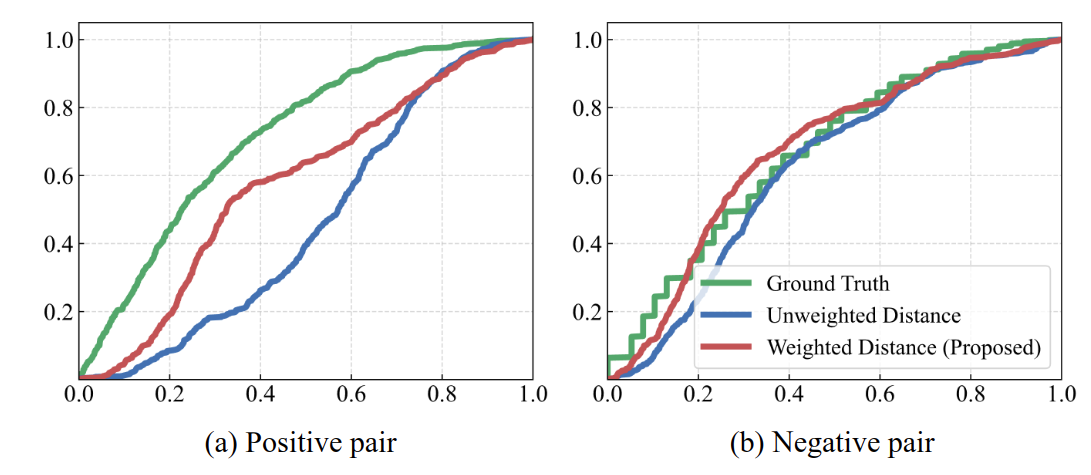
The proposed weighting aligns descriptor distances with ground-truth spatial separation: it yields lower Kolmogorov-Smirnov statistics than the unweighted variant for both positive and negative pairs, mitigating the near-range bias.
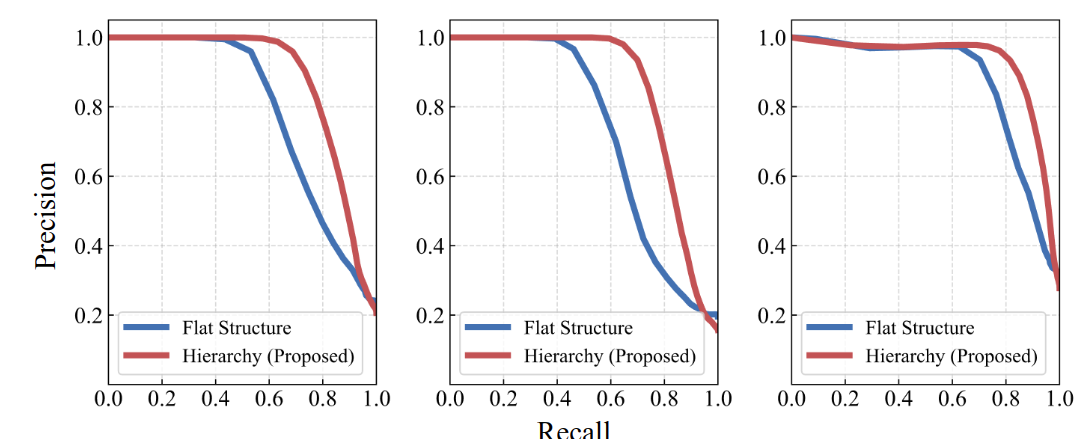
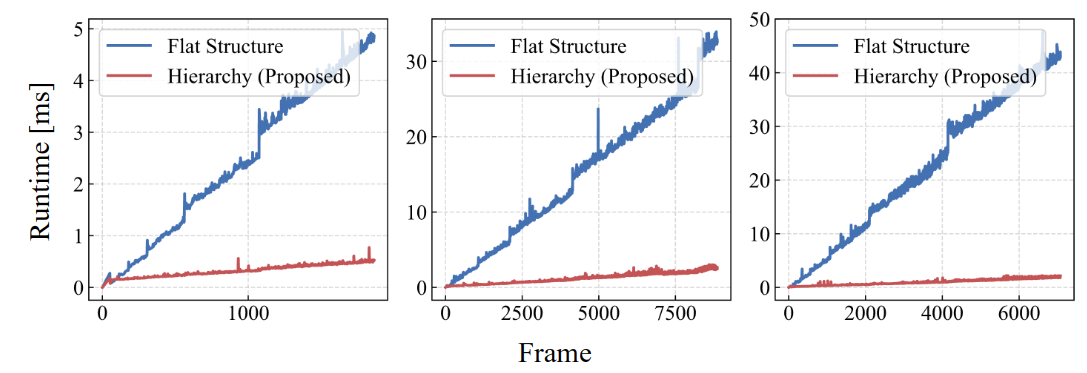
Hierarchical coarse-to-fine retrieval preserves recall comparable to exhaustive flat search while substantially cutting runtime, with the advantage growing as the database size increases.
The retrieval runtime of the hierarchical search scales far better than exhaustive flat search, with the gap widening as the database grows.
@inproceedings{kim2026radloc,
  author    = {Kim, Hogyun and Choi, Jiwon and Lee, Jungwoo and Cho, Younggun},
  title     = {RadLoc: Radar-based 3-DoF Global Localization via Fast, Robust, and Lightweight Spatial Descriptor Across Diverse Environmental Scenarios},
  booktitle = {IEEE/RSJ International Conference on Intelligent Robots and Systems (IROS)},
  year      = {2026},
}

@article{kim2026radloc,
  title={RadLoc: Radar-based 3-DoF Global Localization via Fast, Robust, and Lightweight Spatial Descriptor Across Diverse Environmental Scenarios},
  author={Kim, Hogyun and Choi, Jiwon and Lee, Jungwoo and Cho, Younggun},
  journal={arXiv preprint arXiv:2607.08115},
  year={2026}
}