
Freeze-Frame With StaticNeRF: Uncertainty-Guided NeRF Map Reconstruction in Dynamic Scenes
Authors: Juhui Lee, Geonmo Yang, Seungjun Ma, and Younggun Cho
Abstract: Recent advances in neural representations have shown great promise for enabling high-fidelity dense mapping in robotics. Given the inherently dynamic nature of real-world environments, many studies have attempted to learn static scene representations from dynamic observations. However, existing methods often fail to remove subtly moving objects and struggle to accurately recover occluded static backgrounds, which leads to critical limitations in practice. Furthermore, when static neural maps are used for localization, dynamic content in query images must be handled effectively. To overcome these challenges, we propose a static neural mapping framework that is robust to diverse dynamic environments and capable of processing dynamic content during localization. We evaluated our approach through extensive experiments on both public and in-house datasets. Our method improves both dynamic object removal and localization robustness under dynamic conditions, and constitutes a significant step toward resilient robot navigation in real-world environments.
Session: Tuesday, 09:00-10:30 / Interactive Session 1, Hall C / Paper TuI1I.358
Project Page
KISS-IMU: Self-supervised Inertial Odometry with Motion-balanced Learning and Uncertainty-aware Inference (Finalist: WiRA Student Paper & Best Paper on Robot Perception)
Authors: Jiwon Choi, Hogyun Kim, Geonmo Yang, Juhui Lee, and Younggun Cho
Abstract: Inertial measurement units (IMUs), which provide high-frequency linear acceleration and angular velocity measurements, serve as fundamental sensing modalities in robotic systems. Recent advances in deep neural networks have led to remarkable progress in inertial odometry. However, the heavy reliance on ground truth data during training fundamentally limits scalability and generalization to unseen and diverse environments. We propose KISS-IMU, a novel self-supervised inertial odometry framework that eliminates ground truth dependency by leveraging simple LiDAR-based ICP registration and pose graph optimization as a supervisory signal. Our approach embodies two key principles: keeping the IMU stable through motion-aware balanced training and keeping the IMU strong through uncertainty-driven adaptive weighting during inference. To evaluate performance across diverse motion patterns and scenarios, we conducted comprehensive experiments on various real-world platforms, including quadruped robots. Importantly, we train only the IMU network in a self-supervised manner, with LiDAR serving solely as a lightweight supervisory signal rather than requiring additional learnable processes. This design enables the framework to ensure robustness without relying on joint multi-modal learning or ground truth supervision.
Session: WiRA — Tuesday, 12:50-13:20 / Riesenrad Restaurant, VIECON
Session: Award — Tuesday, 18:05-18:15 / Hall A2 / Paper TuBT1.9

MSG-Loc: Multi-Label Likelihood-Based Semantic Graph Matching for Object-Level Global Localization
Authors: Gihyeon Lee, Jungwoo Lee, Juwon Kim, Young-Sik Shin, and Younggun Cho
Abstract: Robots are often required to localize in environments with unknown object classes and semantic ambiguity. However, when performing global localization using semantic objects, high semantic ambiguity intensifies object misclassification and increases the likelihood of incorrect associations, which in turn can cause significant errors in the estimated pose. Thus, in this letter, we propose a multi-label likelihood-based semantic graph matching framework for object-level global localization. The key idea is to exploit multi-label graph representations, rather than single-label alternatives, to capture and leverage the inherent semantic context of object observations. Based on these representations, our approach enhances semantic correspondence across graphs by combining the likelihood of each node with the maximum likelihood of its neighbors via context-aware likelihood propagation. For rigorous validation, data association and pose estimation performance are evaluated under both closed-set and open-set detection configurations. In addition, we demonstrate the scalability of our approach to large-vocabulary object categories in both real-world indoor scenes and synthetic environments.
Session: Wednesday, 15:00-16:30 / Interactive Session 4, Hall C / Paper WeI2I.398
Project Page
GSAT: Geometric Traversability Estimation using Self-supervised Learning with Anomaly Detection for Diverse Terrains
Authors: Dongjin Cho, Miryeong Park, Juhui Lee, Geonmo Yang, and Younggun Cho
Abstract: Safe autonomous navigation requires reliable estimation of environmental traversability. Traditional methods have relied on semantic or geometry-based approaches with human-defined thresholds, but these methods often yield unreliable predictions due to the inherent subjectivity of human supervision. While self-supervised approaches enable robots to learn from their own experience, they still face a fundamental challenge: the positive-only learning problem. To address these limitations, recent studies have employed Positive-Unlabeled (PU) learning, where the core challenge is identifying positive samples without explicit negative supervision. In this work, we propose GSAT, which addresses these limitations by constructing a positive hypersphere in latent space to classify traversable regions through anomaly detection without requiring additional prototypes (e.g., unlabeled or negative). Furthermore, our approach employs joint learning of anomaly classification and traversability prediction to more efficiently utilize robot experience. We comprehensively evaluate the proposed framework through ablation studies, validation on heterogeneous real-world robotic platforms, and autonomous navigation demonstrations in simulation environments.
Session: Thursday, 09:00-10:30 / Interactive Session 5, Hall C / Paper ThI1I.342
Project Page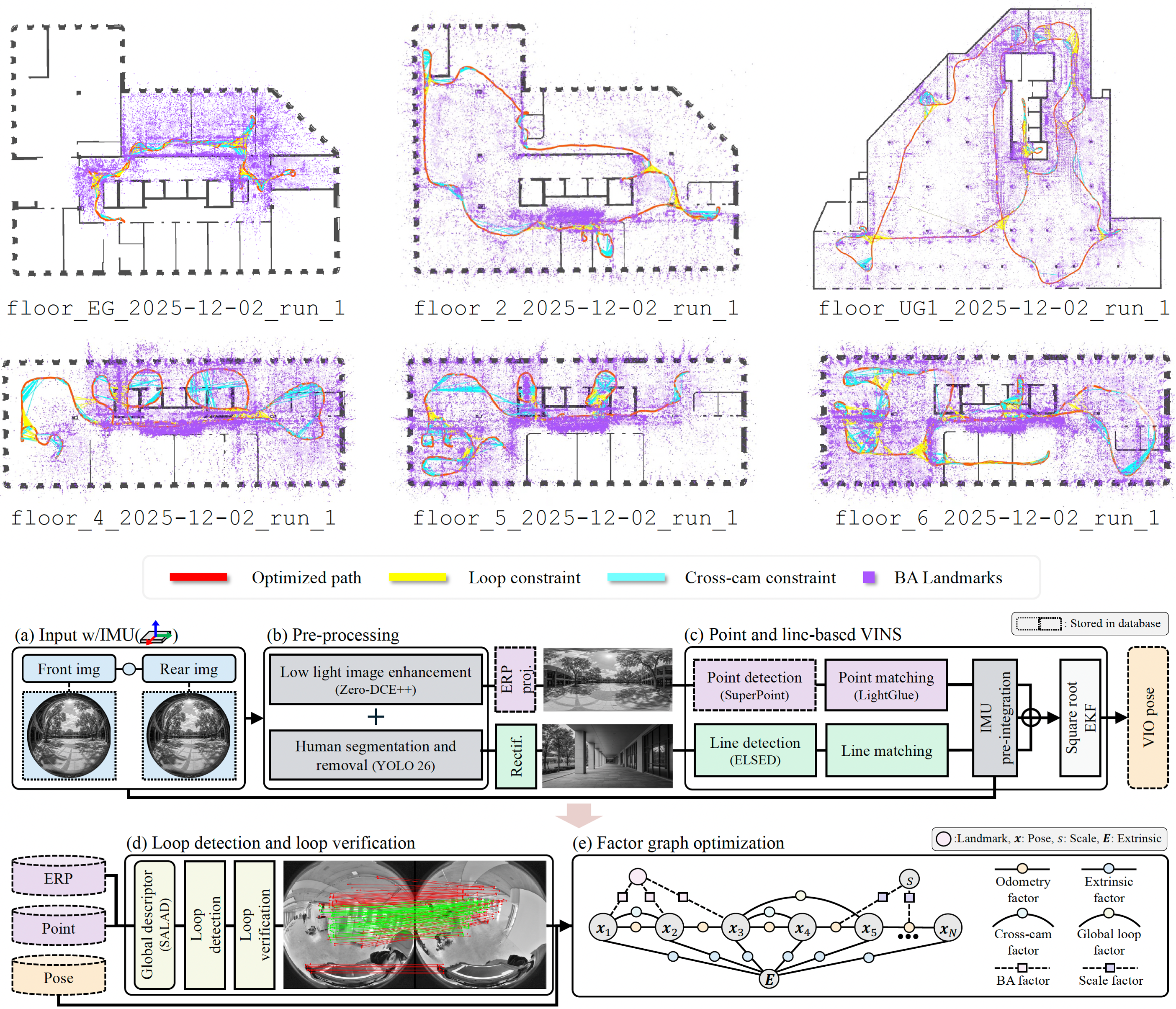
Hilti-Trimble SLAM Challenge 2026 (2nd Place for SLAM Category)
Authors: Jungwoo Lee, Hogyun Kim, Jiwon Choi, Jinyong Jeong, and Younggun Cho
Abstract: This report describes our submission to the 2026 Hilti-Trimble SLAM Challenge. The system is a 360-camera visual-inertial pipeline that uses only the provided dual-fisheye image streams and IMU measurements. First, raw images are preprocessed with low-light enhancement and static/dynamic masking, and then fed into a √VINS frontend as the local odometry, with deep learning-based SuperPoint features, ELSED line segments, and LightGlue matching. The resulting trajectory is refined using a GTSAM-based backend that performs tightly-coupled factor graph optimization with SALAD global descriptors and visual bundle adjustment (BA). The backend performs local-to-global structureless BA, tightly regularized intrinsic and extrinsic refinement, and global scale adjustment supported by the known inter-camera baseline and cross-view constraints. The design targets long indoor sequences with dark regions, repetitive corridors, dynamic objects, and limited geometric parallax, while keeping the pipeline reproducible in the provided ROS2 workspace.
Session: Friday, 11:40-12:10 / Workshop on Open Challenges in Robotics for Asset Inspection and Management (OCRAIM)
Project Page